How to Find the Best School for Long Term Success: A Parent's Complete Guide
May 03, 2026
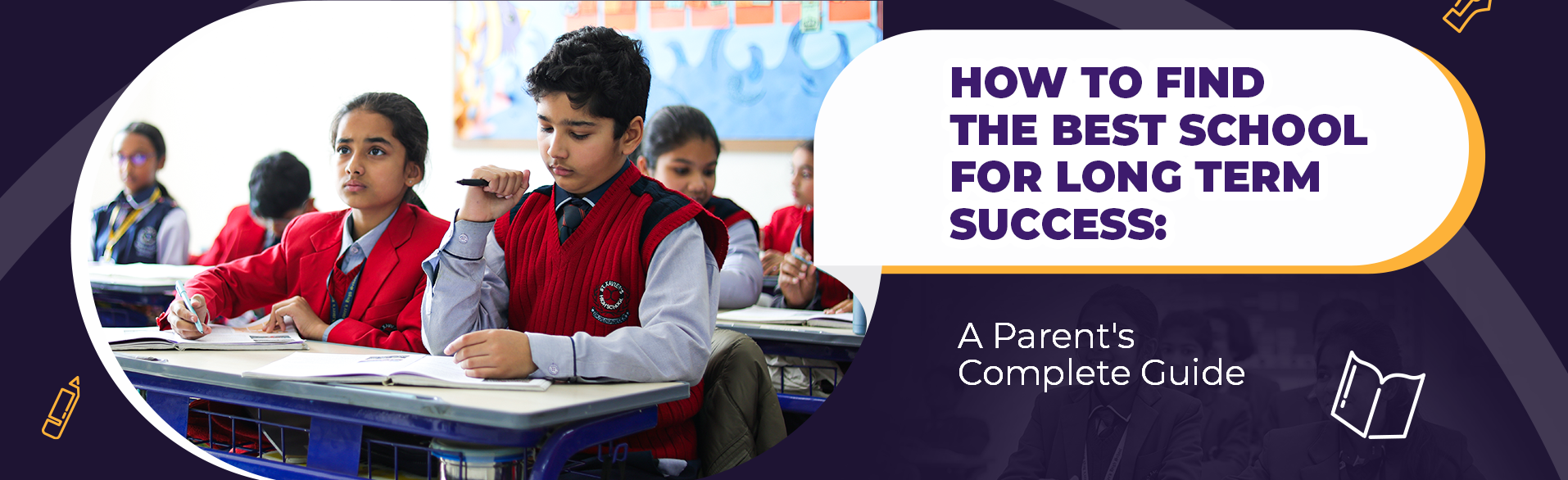
Finding the best school for long term success sounds like a straightforward research project until you are actually inside it.
You spend three weekends visiting campuses. You sit through four different admissions presentations that all sound identical by the third one. Every school claims to build future leaders. Every prospectus uses the same photographs of children laughing in well lit science laboratories. And yet the decision still feels completely impossible.
- Every campus tour is a carefully rehearsed performance, not an honest audit.
- Online rankings measure aggregate board scores, not daily institutional culture.
- Fee structures tell you the cost but absolutely nothing about the actual value delivered.
You are not just choosing a building. You are choosing the daily environment that will quietly shape your child's confidence, intellectual curiosity, and fundamental relationship with learning for the next several years. That weight is real. And it deserves a significantly better framework than a ratings app on your phone.
Following a Real School Selection Guide Parents Can Actually Use
A practical school selection guide parents can genuinely rely on starts not with the campus infrastructure but with the people operating inside it. A beautiful campus with a constantly rotating teaching staff is a fundamentally unstable environment for a developing child. Stability and consistency in the adults around them matters far more than the size of the swimming pool or the brand of the smart boards installed in every classroom.
Ask the admissions team directly how long the average senior teacher has been at the school. Ask what the management does when a student is falling behind academically, not just what they say they do in the prospectus. Those two questions alone will tell you more about a school's actual operational culture than any amount of printed marketing material ever could.
- A school that retains its teachers for five or more years builds institutional memory.
- Long standing educators know the families, the patterns, and the individual personalities.
- Children learn better from consistent adults who understand their specific working style.
- High staff turnover signals internal management pressure that always eventually reaches the students.
Watch the support infrastructure carefully. Not whether a counsellor's name exists on the staff list somewhere. Whether that counsellor is actually accessible, known to the students by first name, and genuinely approached when something is wrong.
Why Future Focused School Education Changes Everything
Prioritizing future focused school education requires parents to think about the world their child will graduate into in the mid 2030s rather than the world they personally navigated in the early 2000s. The professional landscape your child will inherit looks almost nothing like the one that shaped your own academic decisions.
Artificial intelligence is already changing the fundamental nature of knowledge work. Information retrieval is no longer a competitive skill. Critical thinking, creative synthesis, ethical reasoning, and collaborative problem solving are the capabilities that will actually differentiate professionals in that landscape. And those specific competencies are not built by memorizing textbook chapters for standardized examinations.
- Does the school integrate practical problem solving into its daily curriculum structure?
- Are students taught how to evaluate conflicting information sources or just how to memorize approved answers?
- Does the physical education program teach team dynamics and resilience alongside physical fitness?
- Are students given genuine leadership responsibilities or are they just observed and assessed?
A future focused campus treats every subject as a vehicle for building thinking skills, not just a syllabus to be covered and examined. That distinction sounds subtle. In practice it produces two completely different kinds of graduates.
Evaluating the Best CBSE School in Gurugram Honestly
Choosing the best CBSE school in Gurugram requires looking past the generic ranking lists that most parents screenshot and share in neighbourhood WhatsApp groups. Those lists rank on aggregate board exam percentages and infrastructure photographs. Neither data point captures what actually happens inside a classroom on a completely ordinary Friday afternoon when the week is long and the students are tired.
Consider a family from DLF Phase 2 who made their school selection decision based purely on a prestigious campus's consistently high Class 12 results. The infrastructure was exceptional. The academic pressure was equally exceptional. By Class 8, their daughter was waking up at five every morning not because she was motivated but because she was terrified of falling behind her constantly competing peer group.
- She stopped reading fiction entirely because every hour felt like it had to produce marks.
- She quit her painting class midway through the academic year to create more revision time.
- She started measuring her personal worth entirely through her quarterly rank on the class board.
That is not academic success building. That is anxiety manufacturing. And it happens quietly in institutions that optimize for output metrics while treating everything else as secondary noise. The right campus produces students who can handle pressure without being completely defined by it.
Identifying the Right School for Child Future Confidently
Finding the right school for child future planning means aligning the institution's specific operational culture with your child's individual personality, not just their current academic performance level. A high performing analytical child and a creative, emotionally sensitive child require different daily environments to genuinely thrive. Putting both into the same intensely competitive, results driven campus because the board scores look impressive is a fundamentally flawed strategy.
Visit the shortlisted campus on a completely ordinary Wednesday. Not during an open house event. Not during sports day or annual day preparations. A plain, unremarkable working day where nothing special is being performed for visiting parents.
- Notice whether students in the corridors look relaxed or perpetually rushed and guarded.
- Observe how a teacher responds when a student asks a question during an informal moment.
- Watch whether the administrative staff treats a simple enquiry with warmth or visible impatience.
- Pay attention to whether the campus feels purposeful and energetic or silently pressurized.
That ambient emotional temperature cannot be staged on a random Wednesday afternoon. A campus either feels genuinely safe for children or it does not. Trust that specific instinct completely. Your gut response during an unannounced visit is one of the most accurate diagnostic tools available to any parent during this decision.
Choosing St. Xavier's for Long Term Academic Success
At St. Xavier's High School, Sector 89, we do not ask parents to take our word for any of this. We actively encourage unscheduled visits because our daily operational standard does not change based on whether a prospective family is walking through the gate that morning.
Our counselling framework is active and genuinely student facing. Our teacher retention is strong. Our extracurricular programs are open to every enrolled student regardless of existing talent level. And our academic support structure catches children before a small confusion becomes a deep, damaging knowledge gap.
Book a campus visit today and come on a Wednesday. Walk the hallways during a regular period change. Watch how we actually work. The best school for long term success is not the one with the most impressive entrance gate. It is the one that treats your child like a complete, developing human being every single ordinary day of the academic year.